How Much Cash Should You Really Be Holding?
When it comes to building long-term wealth, we often talk about the importance of investing, growing your assets and making your money work harder over time.
But not every dollar needs to be invested.
In fact, having money sitting in cash can be just as important to your financial plan as the investments you hold.
The challenge is knowing how much cash is enough.
Hold too little, and an unexpected expense could leave you financially vulnerable.
Hold too much, and you may be missing opportunities to grow your wealth over the long term.
The goal is not simply to have more cash or less cash. It is to make sure the money you hold has a clear purpose.

Why cash still matters in a financial plan
Cash might not offer the same long-term growth potential as other investments, but it serves a very different purpose.
While investments are generally designed to help build wealth over time, cash provides accessibility, stability and flexibility.
And those things can become particularly valuable when life does not go according to plan.
An unexpected medical expense, a change in employment, a major home repair or a sudden reduction in household income can all place pressure on your finances.
Without money readily available, you may find yourself needing to sell investments, take on additional debt or make changes to your long-term financial strategy.
This becomes particularly challenging if investment markets happen to be experiencing a downturn at the same time.
Having cash set aside can help you manage these situations without immediately disrupting the investments you are relying on for your future.
It can also provide something that is difficult to measure.
Peace of mind.
Knowing you have money available when you need it can make it easier to remain focused on your longer-term goals.
How much cash is enough?
There is no single amount that works for every household.
The right cash balance depends on your income, expenses, financial commitments, lifestyle and stage of life.
A young family with two stable incomes may have very different needs from a business owner with fluctuating cash flow or a retired couple relying on their investments for income.
When thinking about how much cash to hold, there are three important areas worth considering.
1. Money for upcoming expenses
Some expenses are unexpected.
Others are already on the horizon.
Perhaps you are planning a family holiday, replacing a car, renovating your home or preparing for a significant purchase.
If you know you will need that money in the near future, investing it in assets that fluctuate in value may introduce unnecessary risk.
After all, you do not want to be forced to sell an investment at an unfavourable time simply because the money is needed.
Keeping funds for planned short-term expenses readily accessible can help ensure those commitments are covered when the time comes.
It also allows you to separate the money you intend to spend soon from the money you are investing for the future.
2. Money for unexpected expenses
Even the most organised households cannot predict everything.
Cars break down, appliances need replacing, employment circumstances change and unexpected bills arrive.
That is why having an emergency fund is an important part of financial planning.
But how much should you have set aside?
The answer depends on your circumstances.
For example, a household with two reliable incomes may have greater flexibility than a family relying on one income.
A business owner whose income changes throughout the year may need a different level of protection from someone receiving a consistent salary.
Other considerations include your regular living expenses, existing debt commitments, family responsibilities and how easily you could reduce spending if necessary.
The purpose of an emergency fund is not to generate significant investment returns.
It is to provide financial breathing room when something unexpected happens.
And having that money available can help you avoid making rushed financial decisions during an already stressful time.
3. Money to support your retirement income
For people approaching or already enjoying retirement, cash can take on another important role.
When you are working, your regular income generally helps cover everyday living expenses.
But once you retire, you may begin relying on superannuation, investments and other assets to fund your lifestyle.
That creates a different challenge.
If investment markets experience a downturn while you are drawing money from your portfolio, you may need to sell investments at a time when their value has fallen.
Having an appropriate cash reserve can provide another source of funds for living expenses during periods of market volatility.
This may help reduce the need to sell growth investments at an unfavourable time.
Of course, the amount required will depend on your retirement income strategy, spending needs and overall financial position.
But it highlights why cash can become particularly valuable during the transition from building wealth to drawing on it.
Can you have too much cash?
While holding cash can provide security, there is also a potential downside to keeping more than you need.
Over time, inflation reduces the purchasing power of money.
This means the same amount of cash may buy less in the future than it does today.
And while savings accounts can earn interest, the return you receive after tax and inflation may not always be enough to maintain your purchasing power.
For someone investing towards retirement or another long-term goal, holding a large proportion of their wealth in cash could limit their opportunities for growth.
This does not mean cash should be avoided.
It simply means there needs to be a balance between keeping money accessible today and investing for tomorrow.
Once you understand how much cash is needed for upcoming expenses, emergencies and other financial commitments, it becomes easier to consider what role the remaining money should play in your long-term plan.
Making your cash work with your financial goals
A good financial plan should consider both the money you need today and the money you are building for the future.
That means understanding which funds should remain accessible and which may be better suited to longer-term investments.
For example, money you are saving for a home renovation next year serves a very different purpose from money you are investing for retirement in twenty years.
Trying to manage both goals in exactly the same way may expose you to unnecessary risks or limit your long-term growth potential.
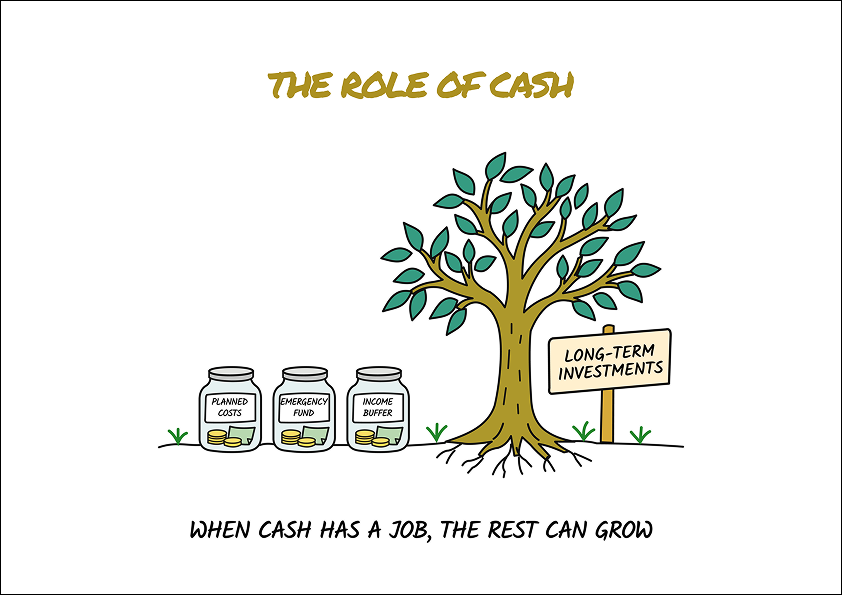
The key is making sure each part of your financial position has a purpose.
Cash provides flexibility and security.
Investments can provide opportunities for long-term growth.
And when used together appropriately, they can help support a financial strategy that balances your current needs with your future goals.
Finding the right balance
There is no perfect cash balance that applies to everyone.
Your circumstances will change throughout your life, and the amount of cash you need may change with them.
Starting a family, purchasing a home, changing careers, running a business or preparing for retirement can all influence how much money you may want to keep readily available.
That is why regularly reviewing your financial position is important.
At Firstlight Financial Planning, we believe cash should have a clear role within your broader financial strategy.
Not simply sitting in an account without purpose, but helping provide the flexibility, security and confidence to make decisions about your future.
Because ultimately, building wealth is not just about how much money you invest. It is also about making sure you have access to the money you need, when you need it.
And finding the right balance between the two can make a meaningful difference to your financial future.
The value of investments and any income from them can fall as well as rise. You may not get back the full amount invested. Past performance should be used as a guide only and is not a guarantee of future performance.
Different investors will view these trade-offs differently depending on their objectives, time horizon and attitude to risk. If you would like to discuss how this relates to your own circumstances, please speak to us.
*Main image from HUM